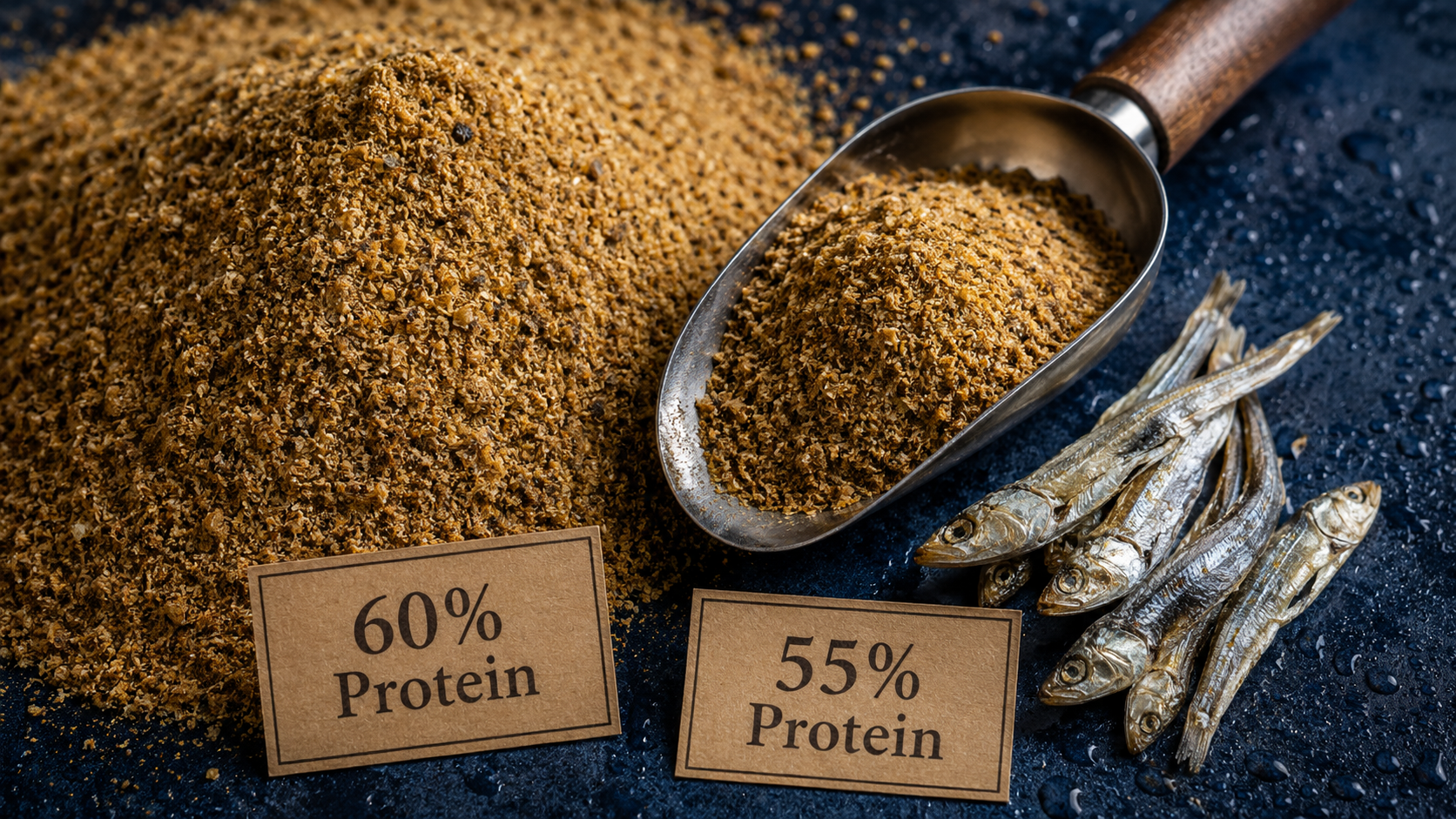
Fishmeal is one of the most nutritionally dense and commercially critical animal feed ingredients in global aquaculture and livestock production. Derived from whole fish or fish trimmings through a process of cooking, pressing, drying, and milling, it provides a concentrated source of high-quality protein, essential amino acids, omega-3 fatty acids, and a suite of micronutrients that are difficult to replicate with plant-based alternatives. Despite the rise of soy and other substitute proteins, fishmeal remains the benchmark ingredient against which feed formulations are measured.
Among buyers, traders, and nutritionists, fishmeal is commonly classified by its crude protein content. The two most commercially prevalent grades are 60% crude protein (FAQ grade) and 55% crude protein — each serving distinct market segments and formulation requirements. Understanding what separates these grades and why every specification parameter carries nutritional and economic weight is essential for informed procurement and quality assurance.
01. What Is Fishmeal, and How Is It Made?
Fishmeal production begins with the selection of raw material — typically whole pelagic fish species such as anchoveta, menhaden, sardine, or sand eel, or by-products from fish processing facilities (trimmings, offcuts, and viscera). The quality of this raw material is the single largest determinant of the final product's nutritional profile.
The Production Process
Fish are subjected to indirect steam cooking at controlled temperatures to denature proteins and release fat and water. The cooked mass is then mechanically pressed to separate the liquid fraction (stick water) from the solid cake (presscake). The presscake is dried — either by direct flame drying (flame-dried, or FD) or by steam drying (steam-dried, or SD) — and finally ground into a fine meal. The stick water is concentrated through evaporation and reincorporated into the presscake before drying, which contributes to the final protein and soluble content.
The drying method significantly influences protein quality. Steam-dried (SD) fishmeal is exposed to gentler heat, preserving a greater proportion of digestible protein and limiting the formation of heat-damaged compounds. Flame-dried (FD) fishmeal tends to have higher crude protein percentages but may carry higher pepsin indigestibility due to over-heating. Most premium-grade products, particularly those destined for aquaculture, are steam-dried.
02. The Two Primary Commercial Grades
While fishmeal is traded across a broad protein spectrum (from below 50% to above 68% in specialized products), the 60% and 55% grades represent the dominant commercial categories in international trade, particularly from South American, Southeast Asian, and European producers.
| Parameter | Fishmeal 60% FAQ | Fishmeal 55% Standard |
|---|---|---|
| Crude Protein (min) | 60.0% | 55.0% |
| Moisture (max) | 10.0% | 10.0% |
| Crude Fat | 8–10% | 9–12% |
| Ash (max) | 16.0% | 18.0% |
| Salt (NaCl, max) | 2.0% | 3.0% |
| Sand / Silica (max) | 0.5% | 1.0% |
| TVN (max) | 120 mg/100g | 150 mg/100g |
| Pepsin Digestibility (min) | 85% | 80% |
| Histamine (max) | 1,000 ppm | 1,500 ppm |
| Antioxidant (Ethoxyquin) | ≤ 150 ppm | ≤ 150 ppm |
| Salmonella | Absent / 25g | Absent / 25g |
| Typical Application | Aquaculture, shrimp feed, piglets | Poultry, swine, cattle, general feed |
The difference between the two grades is not simply a function of protein content — it reflects a broader set of raw material quality, processing discipline, and freshness conditions that cascade through every specification parameter in the table above.
03. Specification Parameters Explained
Each parameter in a fishmeal specification serves a distinct purpose. Together, they paint a complete picture of the product's nutritional value, processing quality, freshness, and safety. Below is a thorough explanation of each key parameter and why it matters.
Primary Nutrient
- Crude Protein (CP)
60% min (FAQ) 55% min (Standard). Crude protein is measured by the Kjeldahl or Dumas method, calculating total nitrogen and multiplying by 6.25. It is the primary commercial differentiator and directly correlates with the cost per unit of protein delivered to the animal. Higher CP generally means less ash and fat relative to the protein fraction, and indicates better-quality raw fish or more efficient processing. For aquaculture species such as shrimp and salmon — which have high protein dietary requirements — the 60% grade is preferred to reduce diet inclusion rates and minimize inert ash load.
- Moisture
Max 10% (both grades)
Moisture content governs shelf life and microbial stability. Fishmeal with moisture above 10% is highly susceptible to mold growth, spontaneous heating (self-ignition in bulk containers), and accelerated protein degradation. On a commercial basis, moisture also affects the true protein yield per tonne: a buyer receiving product at 12% moisture is receiving less dry matter — and therefore less protein — than stated on a dry basis. Most contracts include moisture tolerance clauses with price adjustments for deviations.
- Crude Fat (Ether Extract)
8–10% typical 9–12% typical
Fat provides energy and carries fat-soluble vitamins and omega-3 fatty acids (EPA and DHA), which are critical for fish and shrimp growth, immune function, and flesh quality. However, excess fat — particularly unsaturated fish oil — is prone to oxidative rancidity, which produces peroxides, aldehydes, and free radicals harmful to animal health and feed palatability. Higher-fat fishmeal requires adequate antioxidant treatment and careful storage. The 55% grade, often made from fattier species or by-products, tends to carry a higher fat fraction.
- Ash Content
Max 16% Max 18%
Ash is the inorganic mineral residue remaining after incineration — primarily calcium and phosphorus from fish bones, along with trace minerals. A controlled ash level (12–16%) is actually nutritionally beneficial, as it contributes digestible calcium and phosphorus to the diet. However, excessively high ash (above 18–20%) signals either poor raw material (high bone-to-flesh ratio, use of fish frames) or adulteration with limestone or sand. High ash dilutes the protein fraction and can upset mineral balance in formulated feeds, particularly in shrimp diets sensitive to calcium-to-phosphorus ratios.
- Total Volatile Nitrogen (TVN)
Max 120 mg/100g Max 150 mg/100g
TVN (also written as TVB-N) measures volatile nitrogenous compounds — primarily ammonia, trimethylamine (TMA), and dimethylamine (DMA) — produced by bacterial decomposition of fish protein. It is the most widely used freshness indicator in fishmeal trade. Low TVN indicates that the raw fish was processed quickly after capture and under controlled conditions. High TVN signals that decomposition had already begun before or during processing, resulting in protein degradation, reduced amino acid bioavailability, and potential histamine formation. For sensitive species like shrimp and juvenile fish, TVN above 120 mg/100g is considered unacceptable.
- Pepsin Digestibility
Min 85% Min 80%
Pepsin digestibility measures what percentage of the crude protein can actually be hydrolyzed by pepsin under laboratory conditions — a proxy for in vivo digestibility. This is arguably the most critical quality parameter after crude protein itself. Over-drying or excessive heat during processing causes the Maillard reaction, which cross-links lysine with reducing sugars, forming heat-damaged proteins that are resistant to enzymatic digestion. A product with 62% crude protein but only 75% digestibility delivers less bioavailable nitrogen than a 58% product at 88% digestibility. Premium-grade fishmeal targets pepsin digestibility of 88% or above.
- Histamine
Max 1,000 ppm Max 1,500 ppm
Histamine is a biogenic amine produced by the bacterial decarboxylation of the amino acid histidine, predominantly in scombroid fish species (anchoveta, mackerel, tuna). Its formation is directly linked to inadequate chilling of the catch and delays between capture and processing. Elevated histamine in feed has been associated with gizzard erosion in poultry, gill inflammation in fish, and — through carry-over effects — potential food safety concerns in farmed species destined for human consumption. The 1,000 ppm ceiling in the 60% grade reflects the stricter freshness requirements of aquaculture-grade product. Several markets (EU, Japan) apply even stricter limits.
- Salt (NaCl) & Sand/Silica
NaCl max 2% · Sand max 0.5% NaCl max 3% · Sand max 1%
Salt content reflects the origin of the raw material — fish from certain processing streams may carry residual brine. Excessive salt adds non-nutritive weight, inflates sodium in the diet, and can cause water retention or kidney stress in sensitive species. Sand and silica are inert mineral adulterants with zero nutritional value that physically dilute the product and may cause intestinal abrasion. Both parameters are monitored as indicators of product integrity. Discrepancies between declared ash and the sum of bone minerals plus measured silica are commonly used to detect adulteration.
Antioxidant Treatment
Because fishmeal contains highly unsaturated fats vulnerable to oxidative rancidity, antioxidants are routinely added post-processing. Ethoxyquin (EQ) is the most widely used compound at inclusion levels up to 150 ppm. BHT (butylated hydroxytoluene) and natural tocopherol blends are also applied, particularly in markets where ethoxyquin is restricted or where buyers request "EQ-free" product. Oxidized fishmeal exhibits reduced digestibility, lower vitamin E activity, elevated malondialdehyde (MDA) levels, and reduced palatability. Monitoring peroxide value (PV) alongside antioxidant content is standard practice in quality assurance programs.
Microbiological Safety: Salmonella
Salmonella contamination in fishmeal is a critical food-chain safety concern, as fishmeal is fed to animals that may eventually enter the human food supply. The international standard requires Salmonella to be absent in a 25-gram analytical sample. Cross-contamination during transport, storage, or blending is a known risk — particularly when fishmeal is stored alongside raw grain. Reputable suppliers provide certificates of analysis (COA) with Salmonella testing results for each production lot.
04. Choosing Between 60% and 55%: Application Considerations
The decision between the two grades is driven primarily by the target species and the economic sensitivity of the formulation.
Aquaculture applications — particularly shrimp, salmon, sea bass, and sea bream — demand the highest protein quality and the lowest risk of histamine and TVN exceedance. These species have limited tolerance for heat-damaged proteins and are highly sensitive to feed palatability. The 60% FAQ grade is the standard for high-performance aquafeed, and premium shrimp feed manufacturers often source fishmeal with pepsin digestibility above 88% and TVN below 80 mg/100g — well inside the specification ceiling.
Terrestrial livestock applications — broiler and layer poultry, swine grow-finish, and ruminant dairy supplementation — can tolerate the broader specification windows of the 55% grade. In these formulations, fishmeal is used as an amino acid balancer and palatability enhancer at relatively low inclusion rates (2–8%), and the marginal cost savings per tonne of the 55% grade are commercially meaningful at large scale.
From a cost-efficiency perspective, buyers should evaluate fishmeal on a digestible protein per tonne basis rather than on crude protein percentage alone. A 60% product at 87% digestibility delivers approximately 522 kg of digestible protein per tonne. A 55% product at 78% digestibility delivers approximately 429 kg — a difference of nearly 20% in functional protein despite a smaller spread in the headline number. Price premiums for the 60% grade are generally well-justified when the full formulation economics are modeled correctly.
05. Quality Assurance and Procurement Best Practices
For buyers entering the fishmeal market — whether for direct feed production or commodity trading — the following practices are considered standard in well-managed supply chains:
1. Request a Full Certificate of Analysis (COA)
A complete COA should cover, at minimum: crude protein, moisture, crude fat, ash, TVN, pepsin digestibility, histamine, salt, sand, antioxidant type and level, and Salmonella status. Partial COAs covering only protein and moisture should be treated with caution in high-value procurement.
2. Conduct Independent Third-Party Testing
Reputable suppliers will accept — and often encourage — independent sampling and analysis at origin or destination. Third-party laboratories accredited to ISO 17025 standards provide the most defensible analytical results for dispute resolution.
3. Monitor Origin and Species Transparency
The species composition of the raw material influences the amino acid profile, fat quality, and histamine risk. Fishmeal derived from histidine-rich species (anchoveta, mackerel) carries inherently higher histamine risk than that from whitefish by-product. DNA-based species identification is increasingly available for premium market verification.
4. Assess Storage and Logistics Conditions
Even premium-specification fishmeal can degrade rapidly if stored in humid, poorly ventilated conditions or exposed to contamination during bulk transshipment. Bulk container shipments should include moisture indicator cards, and product temperature at loading should be confirmed to prevent self-heating incidents.
06. Conclusion
Fishmeal remains an irreplaceable ingredient in high-performance animal nutrition, and understanding its specification parameters is foundational to making sound procurement, formulation, and quality assurance decisions. The distinction between 60% and 55% crude protein grades extends well beyond a single number — it reflects an integrated picture of raw material quality, processing discipline, freshness management, and product safety.
Every parameter in the specification tells a part of that story. Crude protein sets the commercial baseline. Pepsin digestibility reveals whether that protein is biologically available. TVN and histamine speak to the freshness of the raw fish. Ash and sand signal the integrity of the raw material and the absence of adulteration. Moisture and fat content determine shelf stability. And microbiological parameters ensure the safety of the entire downstream food chain.
Whether sourcing fishmeal for an aquaculture feed mill, a poultry integrator, or as a commodity trader assessing quality on behalf of a buyer, reading a fishmeal specification with full analytical literacy is not optional — it is the foundation of responsible and commercially sound practice.