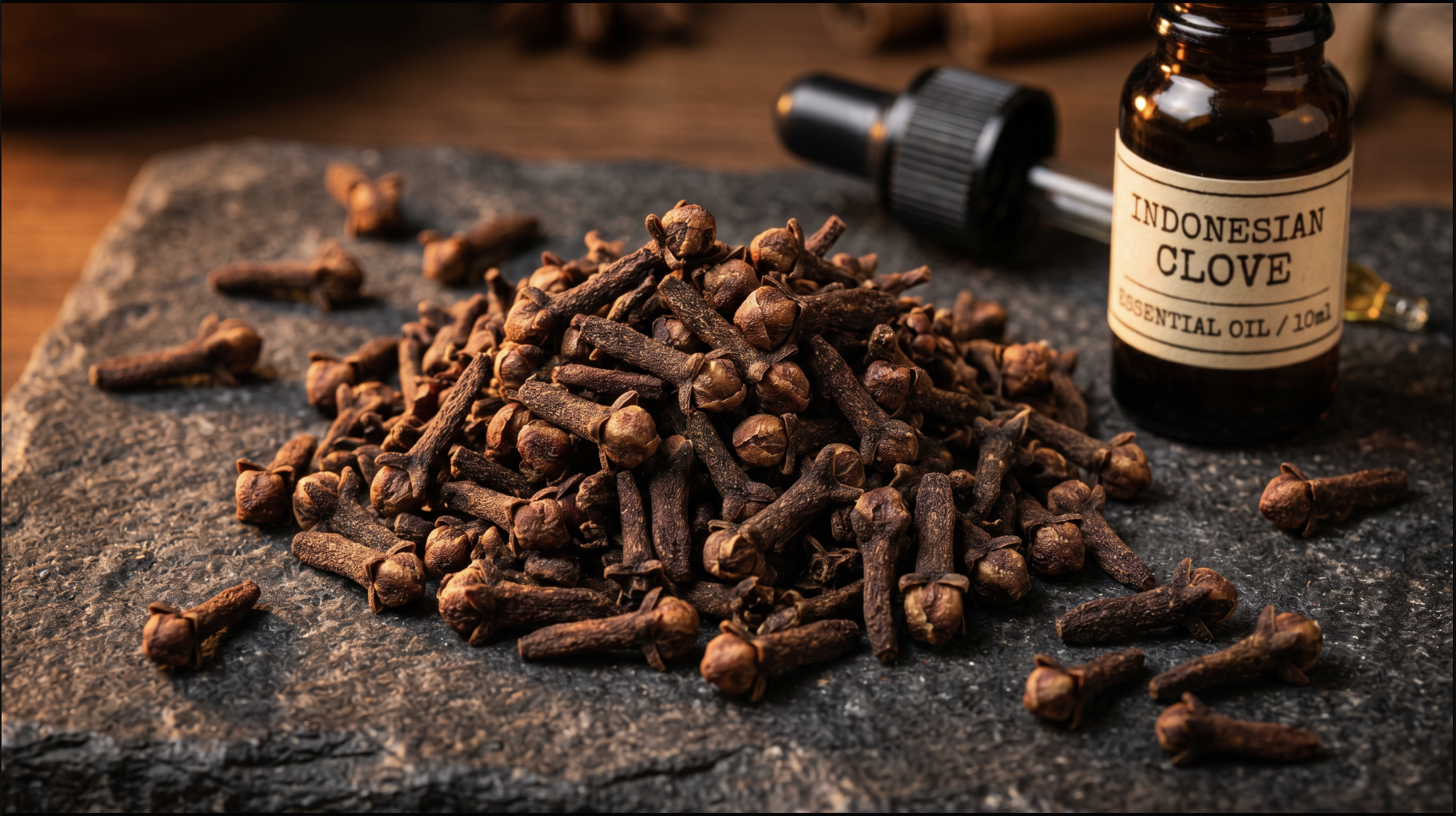
Indonesia supplies roughly 75–80% of the world's cloves. This is not a recent development — cloves are native to the Maluku Islands (the original "Spice Islands"), and Indonesia has dominated global production for centuries. If you are buying cloves at any significant volume, you are almost certainly buying Indonesian origin, directly or through a trader who is.
That dominance has implications for buyers. It means supply concentrates here, pricing reflects Indonesian domestic dynamics (particularly the kretek cigarette industry, which consumes a large share of domestic production), and quality varies significantly depending on where in the supply chain you're sourcing.
Production Regions
Most Indonesian cloves come from three areas:
Maluku (Maluku Islands) is the original source — historically, the only place in the world where cloves grew until the Dutch broke the monopoly in the 18th century. Maluku cloves are still considered among the best in terms of eugenol content and aroma intensity.
North Sulawesi is now the largest producing region by volume. The growing conditions produce a consistent, well-regarded commercial grade clove. Most bulk export cloves that enter international food and flavor markets originate here.
East Java and Zanzibar-origin varieties transplanted to Java produce smaller volumes, used largely for the domestic kretek market.
The Kretek Variable
Indonesian cloves are not primarily exported. The domestic kretek cigarette industry — Indonesia has one of the largest cigarette markets in the world, and kreteks (clove-blended cigarettes) are the dominant category — absorbs roughly 60–70% of domestic clove production.
This matters to buyers because it means:
-
Export supply is the residual after domestic demand is satisfied
-
When domestic kretek demand is high, export prices rise
-
Seasonal supply availability is real — plan sourcing with lead time buffer
For international food, pharmaceutical, and flavor manufacturers, this supply dynamic is the single most important thing to understand about Indonesian cloves pricing. It's not primarily driven by your demand.
Quality Parameters
Cloves are evaluated on several key parameters:
Eugenol content: Eugenol is the primary active compound in cloves, responsible for the characteristic aroma and flavor, and the reason cloves are used in pharmaceutical and flavor applications. High-quality Indonesian cloves run 70–90% eugenol content in the essential oil. This is what your flavor house or extraction supplier cares about most.
Moisture content: Export grade cloves should be ≤12% moisture. Higher moisture leads to mold development during transit and storage. Always request moisture data and verify on arrival.
Stem-to-bud ratio: Cloves are sold as whole buds (flores/flower buds), clove stems, or a mixture. Stems have lower eugenol content than buds. Confirm the product specification clearly — "whole cloves" can sometimes mean a bud/stem mix depending on the supplier.
Foreign matter and defects: Broken buds, immature buds, and foreign matter are scored against export grade specifications. Indonesian export grade specifications (SNI 06-2387) set limits on:
-
Broken/damaged buds: ≤1%
-
Foreign matter: ≤0.5%
-
Moisture: ≤12%
Color and appearance: Export-quality cloves should be dark reddish-brown to near-black, with intact buds and visible oil glands. Pale or gray coloring indicates old stock or improper drying.
Forms Available for Export
Whole cloves (buds): The primary export form. Used in food manufacturing, extraction, and retail.
Clove stems: Lower eugenol content, cheaper. Used in flavor extraction and some industrial applications.
Clove powder: Available but less common in bulk export — buyers typically grind domestically to control particle size and prevent adulteration.
Clove essential oil: Extracted from buds, stems, or leaves. Bud oil has the highest eugenol content and commands the highest price. Leaf oil is cheaper and more commonly used in industrial flavor and fragrance applications.
If you're sourcing for pharmaceutical or food-grade essential oil applications, specify the source material (bud vs. leaf vs. stem) and request GC-MS analysis data to verify eugenol content and purity.
Applications: Who Buys Indonesian Cloves
Food manufacturing: Whole cloves and clove powder in spice blending, pickling, sauces, and baked goods. Food-grade buyers need documentation for heavy metals, pesticide residues, microbial limits (EU 2073/2005 or equivalent), and aflatoxin.
Pharmaceutical: Eugenol is used in dental products (clove oil for toothache is well-established), antiseptics, and some drug formulations. Pharmaceutical-grade buyers require USP/BP grade specifications and full CoA documentation.
Flavor and fragrance: Clove bud oil and eugenol derivatives are used extensively in flavor creation and perfumery. Buyers in this segment typically require IFRA compliance documentation and GC-MS certificates.
Tobacco (Kretek OEM): Less relevant for international buyers, but if you are in the tobacco supply chain, Indonesian origin dominates.
Documentation for Import
Depending on your destination market, Indonesian clove exports require:
-
Certificate of Origin (COO) — issued by KADIN or relevant trade authority
-
Phytosanitary Certificate — mandatory for plant-based commodities
-
Health Certificate — for food-grade applications
-
Certificate of Analysis — moisture, eugenol content (for oil), defect count, heavy metals, pesticide residues
-
GC-MS Report — required by most pharmaceutical and flavor buyers for essential oil
EU buyers should verify compliance with EC Regulation 1334/2008 on flavoring substances and EC 231/2012 for food additives. US buyers should confirm FDA requirements for imported spices (21 CFR Part 117 for food safety).
What Nusagrade Sources
Nusagrade exports whole clove buds and clove stems from North Sulawesi and Maluku origins. Our supply comes from verified collection points with documented drying and moisture control.
We do not blend old stock with new harvest. Every shipment is from the current or immediately prior season.
Available specifications:
-
Whole clove buds, SNI Grade Export, moisture ≤12%, broken buds ≤1%
-
Clove stems, commercial grade
-
Custom sorting and grading available for volume buyers
Packaging: 25kg and 50kg PP woven bags, with inner PE liner. Bulk bag (500kg–1MT) available for industrial buyers on request.
MOQ: 1MT for whole cloves (samples available prior to commitment), with FCL pricing for 10MT+.
Documentation: Full export documentation including COO, Phytosanitary Certificate, and CoA provided as standard.
Pricing Context
Clove prices are volatile. They follow Indonesian domestic supply-demand more than international commodity benchmarks. Buyers who establish direct relationships with Indonesian exporters — rather than buying through third-country traders — typically access better pricing and more reliable supply continuity.
Spot market purchasing for cloves is high-risk. Plan 6–12 weeks out and maintain safety stock if cloves are a core input for your production.
Contact
For samples, pricing, and supply terms: contact@nusagrade.com or nusagrade.com/contact .
Nusagrade — Premium Grade. Pure Indonesia.